There’s been a lot of buzz lately about AI building products on its own. Roblox just launched a feature called “Build” that lets anyone create a game straight from their phone, no coding needed. Samsung is also pushing Galaxy AI hard for everyday productivity tasks.
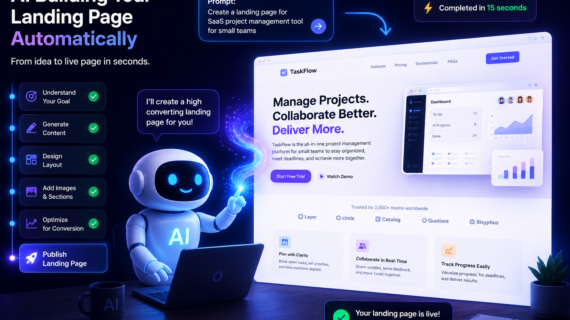
That trend has spilled over into websites too. These days, AI building landing pages isn’t unusual at all. Plenty of new tools promise instant results from a single text prompt.
So here’s the question: if AI building landing pages is that easy, do businesses still need a human developer? The answer is yes, and the reasons are pretty clear.
AI Speeds Things Up, But It Doesn’t Understand Your Business Yet
Generative AI is genuinely fast. It can produce draft copy, a basic layout, or several design variations in seconds. But a landing page that actually converts visitors into customers needs more than a good-looking layout.
There’s business logic behind every element. How the funnel is structured so visitors don’t get confused. How conversion tracking gets set up through Meta Pixel or GA4. How loading speed stays fast through a CDN like Cloudflare.
All of that works together toward one goal: real results. Unfortunately, AI can’t read that kind of business context yet. It also can’t adjust marketing strategy for a specific audience.
So when AI builds a landing page, what you get is usually just a starting skeleton. A human developer is still needed to refine it and align it with actual business goals.
Where AI Genuinely Helps
That said, AI still brings real value. A few things have already proven to speed up a landing page developer’s day-to-day work.
Initial content drafts. AI can put together a copywriting outline quickly. Developers or marketing teams just need to polish it to match the brand voice.
Workflow automation. Tools like N8N let forms, CRMs, and chatbots connect automatically. The process runs without rewriting code every time a business process changes.
AI chatbots for first response. A chatbot can answer basic visitor questions around the clock. The sales team only steps in once questions get more specific.
With this combination, work gets more efficient. AI handles the repetitive stuff, while people focus on strategy and fine-tuning.
The Risk of Relying on AI Too Much
The biggest temptation with the AI-building-landing-pages trend is assuming everything becomes instant and risk-free. In reality, that’s not always true.
Generative AI output often still needs a second look. That covers security, speed, and SEO compliance. Skip that audit, and new problems usually show up later.
Take a website built fast with no technical optimization. It looks fine at first. But after a few months, search rankings can drop and conversion performance can weaken.
AI also tends to produce content that feels generic. It looks polished, but it can feel impersonal. Yet a potential customer’s trust often comes from small, human details.
That’s why AI output should always get a second review from an experienced developer. Not to reject AI, but to make sure the result is actually good enough to use.
How Businesses Can Use This Trend Wisely
To avoid missteps, there are a few safe ways to approach the AI-building-landing-pages trend. This approach works for small businesses and large companies alike.
First, treat AI as a starting point, not the final product. Let AI draft the first version, then hand it to a developer for refinement.
Second, keep running regular technical audits. Check loading speed, security, and SEO structure every few months.
Third, keep a human touch in the content. Match the tone to the brand’s character so it doesn’t feel stiff or generic.
Fourth, use automation only for repetitive tasks. Let developers focus on strategy, not on work a machine can already handle.
This way, businesses get the speed of AI without losing quality. The result: a landing page that stays effective and still feels personal.
When You Should Still Use a Full Developer
There are situations where AI building landing pages on its own isn’t a good idea. It’s worth knowing these before rushing into fully automated tools.
First, when the landing page connects to payment systems or customer data. Security becomes the top priority, and a small gap can cause big damage.
Second, when the campaign needs detailed tracking. Wrong conversion data can lead to bad marketing decisions. An experienced developer is usually quicker to catch these mistakes.
Third, when the brand has a distinct visual identity. AI tends to produce generic designs that look similar to each other. But a landing page that stands out is usually the one that looks different.
Fourth, when the business needs solid performance across devices. Developers can test and fix the layout across many screen sizes. AI doesn’t always catch details this small consistently.
If any of these apply, it’s best to bring in a developer from the start, not just for cleanup at the end.
Frequently Asked Questions
Can AI building landing pages be used without a developer at all?
It can, but the risk is high. AI’s first output is usually just a basic skeleton. Without a developer’s adjustments, important pieces like conversion tracking or loading speed often get missed.
Is AI building landing pages cheaper than hiring a developer?
It looks cheaper at first. But the cost of fixing problems later is often higher, especially if issues only surface after traffic starts coming in.
What AI tools work well alongside a developer’s work?
Common tools include AI for content drafts, N8N for workflow automation, and AI chatbots for first responses. All three speed up the process, while a developer still oversees the final result.
Will this trend replace landing page developers?
Probably not entirely. The developer’s role is shifting, from building everything from scratch to refining and overseeing AI output. Strategy and technical audit skills are becoming even more valuable.
Conclusion
The AI-building-landing-pages trend is worth following. Its speed is a real advantage, especially for businesses that need quick results.
But speed alone isn’t enough. A landing page that actually works needs strategy, technical audits, and a human touch that AI can’t fully replace.
So this moment is actually a good opportunity. Businesses can combine the speed of AI with the precision of an experienced developer. The result isn’t just a landing page that gets built fast, it’s one that actually works for the business’s goals.