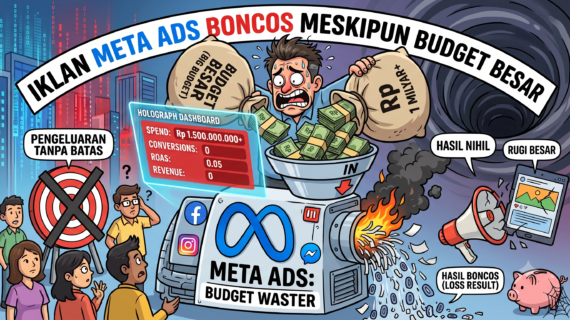
Poured millions into Facebook and Instagram ads, yet the results barely move the needle? You’re not alone. Many business owners think raising the budget is the “safe” fix, but conversions stay flat, and cost per result keeps climbing month after month.
The usual reaction is to add more budget, switch agencies, or give up on Meta Ads entirely. But before making a drastic call, it’s worth checking the fundamentals first. More often than not, the problem isn’t the budget number, it’s one of these five technical and strategic gaps that get overlooked.
1. Targeting That’s Too Broad (or Too Narrow)
Many assume “the wider the audience, the more sales.” But an ad aimed at everyone usually reaches no one effectively. Meta’s algorithm needs clear signals about who your target is so it can optimize properly and find the people most likely to convert.
If your audience is too generic — say, “women, 18-45, nationwide” — the system struggles to tell apart genuine prospects from people just scrolling past. The ad still runs, the budget still gets spent, but the results don’t add up.
On the flip side, targeting that’s too narrow has its own problem. The available audience pool becomes too small, forcing the system to “compete” for the same people over and over. Cost per result climbs as competition within that tiny audience intensifies over time.
The fix: start with an audience specific enough based on interests, behavior, or existing customer data (like a custom audience from your database), then let the algorithm learn and optimize from early conversion data. Don’t rush to change targeting before enough data comes in.
2. Landing Page Doesn’t Match the Ad
This is the most commonly overlooked issue, yet it has a huge impact. People click an ad because they’re drawn to a specific message or offer — say, a 30% discount or a free consultation. But once they land on the page, the message is different, it loads slowly, or it’s unclear what to do next.
Imagine clicking a promo ad, only to land on a generic homepage with no mention of the promo at all. The trust built up by the ad collapses within seconds.
The result: prospects who were interested moments ago bounce before they ever check out or fill out a form. Meta did its job, driving relevant traffic, but the ad budget ends up wasted because the landing page fails to “catch” that interest.
An effective landing page should continue the ad’s message (message match), load fast on mobile since most traffic comes from phones, and have one clear call-to-action so visitors aren’t left guessing what to click.
3. No Data to Optimize With (Pixel Not Set Up Correctly)
Meta Ads works like a machine that gets smarter the more accurate data it’s fed. But if the Meta Pixel or Conversion API isn’t set up correctly, the algorithm runs blind, unable to tell which ads actually drive sales and which ones just generate empty clicks.
This problem often goes unnoticed on the surface. Campaigns keep running, reports keep coming in, but the recorded conversion numbers don’t match what’s actually happening on the website. Sometimes key events like “Purchase” or “Add to Cart” fire twice, or don’t fire at all due to conflicts with another plugin on the site.
As a result, budget keeps getting allocated toward audiences and ads that aren’t actually effective, because the system has no accurate signal to learn from. The longer this goes unnoticed, the further off-track the algorithm’s optimization becomes.
Double-check your pixel setup regularly using Meta Pixel Helper or Events Manager, and make sure key events are recorded correctly and only once per action.
4. The Same Ad Creative, Over and Over
Running the same ad for weeks makes the audience “tired of seeing it” — known as ad fatigue. Performance that was strong initially gradually declines even though budget and targeting haven’t changed, simply because people have seen the same ad too many times in their feed.
The telltale sign is usually a rising frequency paired with a dropping click-through rate (CTR). That’s a signal your creative has gone “stale” in the eyes of the audience, even if from your side the campaign only just launched a few weeks ago.
Beyond visual fatigue, if every creative is pure hard-sell without varying the angle — like a banner that just says “50% Off, buy now” — prospects who aren’t ready to buy yet will simply scroll past. Not everyone who sees an ad is at the buying-ready stage.
Prepare several creative variations with different angles such as educational content, customer testimonials, or before-and-after comparisons, and rotate them regularly to keep the ads fresh in front of your audience.
5. Not Giving the Algorithm Time to Learn
Constantly tweaking campaigns, budgets, or audiences every 1-2 days because “there are no results yet” actually forces Meta’s algorithm to keep restarting from zero. This is known as exiting the learning phase, and the campaign has to gather data all over again.
This is one of the most common mistakes, especially for those new to Meta Ads who panic seeing underwhelming results on day one or two. In reality, the algorithm needs time and a certain volume of data, typically around 50 conversion results within a week, to find the pattern of audiences most likely to convert.
Every major change, like a drastic budget shift, an audience edit, or swapping the main creative, resets the learning phase to zero. If this happens repeatedly before the campaign has a chance to stabilize, performance will never truly reach its optimal point.
Give campaigns at least a few days before judging performance, and avoid drastic changes while still in the learning phase. If a change is necessary, make it gradually rather than all at once.
So, It’s Not Just About Budget
A large budget without the right foundation, targeting, landing page, tracking, creative, and patience with the algorithm, will only burn money faster without matching results. What usually needs fixing isn’t “add more budget,” but “plug the leaks” across these five areas first.
Before rushing to increase next month’s budget, try auditing these five points one by one. The issue might be just one small spot, but its impact can ripple across the entire campaign’s performance.
Need help auditing or setting up more effective Meta Ads? Our team is ready to help, from the technical setup to the creative strategy.